As businesses grow, it becomes more challenging to manage customer information and keep track of relationships and next steps using emails, spreadsheets and documents.
For SMEs, CRM has become a practical way of keeping sales, marketing and customer activity all in one place.
1. CRM has become part of day-to-day operations
CRM used to mean a contact database. Today, it plays a much wider role in how a business runs.
A modern CRM helps track:
- who you're speaking to
- what's been discussed
- what's coming next
- where opportunities sit
 Instead of sales activity living in spreadsheets, emails and personal notes, everything is recorded in one shared system.
That makes it easier to keep momentum, even when work get busy or responsibilities shift.
For small teams, this shared visibility matters. It reduces reliance on memory, avoids duplicated work and gives everyone a clearer picture of what's happening across customer relationships.
2. All your customer data, in one place
Most SMEs already have plenty of customer data. The challenge is that it's often spread out.
- Contacts might sit in Outlook
- Notes might live in notebooks or documents
- Proposals are stored in folders
- Key conversations are lost in email threads
 A CRM pulls all of this into one clear, up‑to‑date view of each customer. Contact details, communication history, notes, opportunities and activity are all stored in a single place, making it easy for anyone on the team to understand the full context at a glance.
In practice, this results in:
-
Less time is spent searching for information
-
Handover between team members becomes simpler
-
Conversations are more consistent
-
Customers don't need to repeat themselves
3. Better visibility leads to better conversations
SMEs often aim to provide a personal and attentive service. That becomes more difficult to maintain as customer numbers grow and information is spread across different places.
CRM helps build a clearer picture over time based on real data and emerging patterns:
-
what customers engage with
-
what they value
-
where relationships are heading
 When conversations are based on accurate, shared information, customers feel understood. That strengthens relationships and helps maintain the personal approach SMEs are known for.
4. The system should reduce effort
One of the most common concerns we hear from SMEs about a CRM is that it is too complex.
There's a fear that CRM will mean more systems to manage, more IT overhead, or another tool that needs constant attention.
Cloud-based CRM platforms have changed that. Updates, backups and security are handled as standard. Data is available wherever the team is working, without needing on-premise infrastructure or specialist maintenance.
When the system is stable and well-set-up, there's no need to
5. Sales and marketing become easier to coordinate
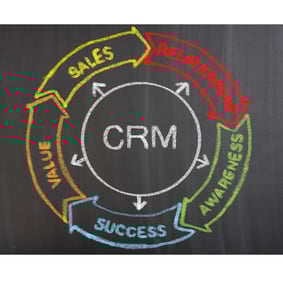 In many small businesses, sales and marketing activities run in close alignment. Leads arrive from different places. Follow-up varies depending on who's involved. It's not always clear which activity leads to meaningful conversations or real opportunities.
A CRM system gives you a unified view of every stage of the customer journey, from the first interaction through to ongoing engagement. It makes it easy to track leads as they move through the sales funnel, showing where they originate, how they progress,
and which activities ultimately drive revenue.
Even without a dedicated marketing team, this visibility helpsdirect effort toward the activities that deliver real value.. Follow-up becomes more consistent, pipelines are clearer, and planning becomes easier.
Choosing a CRM that fits your business
For SMEs new toCRM, success isn’t about choosing the most complex or feature-rich platform.
The right CRM is usually:
-
cloud-based
-
straightforward to use
-
easy to integrate with existing tools
-
flexible enough to adapt as the business grows
 It should support the way the business already works, not force a complete change overnight. A simple, well-implemented CRM often delivers more benefit than a powerful system that's never fully adopted.
What's next
Are you considering a CRM, but want a simple, predictable and cost-friendly way to get started?
Join us for a hands-on webinar on Dynamics 365 Lite on Tuesday 24 February at 11:00 AM. This practical session is for business owners and small teams considering a CRM with a focused, well-defined setup.
Register here: Fast, Affordable, Scalable D365 for SMBs